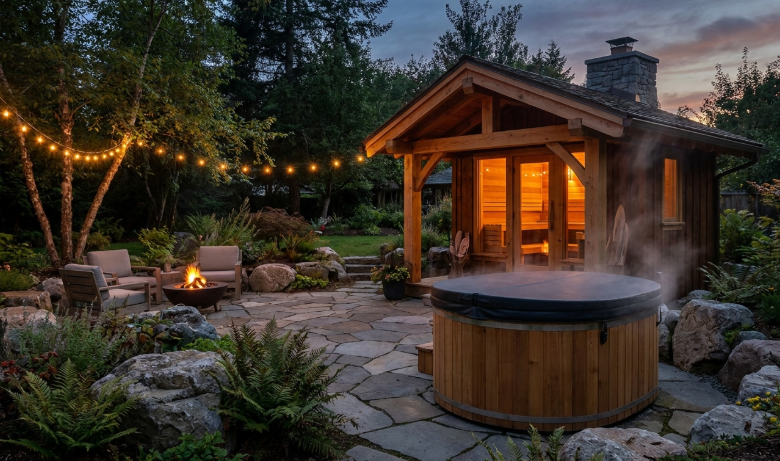
Three sizes cover most 2 person situations: a compact corner unit around 4 by 4 feet for tight spaces, a standard 4 by 5 or 4 by 6 foot cabin for anyone who wants room to stretch out, and a slightly larger 5 by 6 foot layout when the budget and space both allow it. Total installed cost runs roughly $3,500 for the smallest option up to $8,500 for the largest once delivery, a base pad, and electrical work are included. The right choice depends less on the sauna itself and more on the space you actually have and how much clearance you can give the door and heater.
Size Tier One: The Compact Corner Unit (Roughly 4×4 Feet)
This is the entry point for anyone with a small deck, patio corner, or tight side yard. Interior footprint is about 4 by 4 feet with a 6.5 to 7 foot ceiling, using two adults seated on a stepped bench rather than lying flat. Cost breakdown: the cabin and heater together typically run $2,800 to $4,200, delivery adds $150 to $400 depending on distance and access, and a simple gravel or paver pad runs another $300 to $600 if the ground is not already level and solid. Electrical work for a 4.5 kilowatt heater on a dedicated 240-volt circuit adds $500 to $1,200 depending on distance from the panel. Total: roughly $3,750 to $6,400.
See also: Mutf_In: Sbi_Life_1d4zdz0
Size Tier Two: The Standard Cabin (4×5 to 4×6 Feet)
This size is the most common choice for a household of two who want the option to lie down occasionally, and it is where most manufacturers put their best-selling model. Cabin and heater together run $3,500 to $5,500, with the heater typically stepping up to 6 kilowatts to handle the added cubic footage. Delivery and pad costs are similar to the smaller tier, $150 to $600, but electrical work can run slightly higher, $700 to $1,500, since a 6 kilowatt heater often needs a larger breaker and sometimes a longer wire run if the panel is farther from the install site. Total: roughly $4,650 to $7,900.
Size Tier Three: The Larger Two-Person Layout (5×6 Feet and Up)
Some buyers choose a slightly oversized footprint even for two people, mainly for a longer lying bench or a bit of extra room to move without brushing against the heater guard. Cabin and heater costs climb to $5,000 to $7,500, and the heater often steps up again toward 8 kilowatts. Pad and delivery costs stay close to the smaller tiers since the shipping logistics do not change dramatically, but electrical work can reach $1,000 to $2,000 if the larger heater requires a panel upgrade. Total: roughly $6,150 to $10,500, though most buyers in this tier land closer to $8,000.
Why Fixed Costs Change the Math Between Sizes
Delivery, a base pad, and the basic electrical hookup do not scale directly with cabin size the way the unit price does. That means the percentage jump in total cost from a 4×4 to a 4×6 unit is usually smaller than the square footage difference alone would suggest, since a large chunk of the bill is fixed regardless of which size you land on. Buyers on the fence between two sizes should price both options fully installed, not just compare sticker prices on the cabins themselves, before deciding the smaller unit is meaningfully cheaper.
Matching Size to the Space You Actually Have
Measure the intended spot before shopping, not after. Beyond the cabin’s own footprint, plan for at least 24 inches of clearance in front of the door for entry, exit, and the door swing itself, and 6 to 12 inches on the sides or back for the heater’s required clearance and future access for maintenance. A cabin that technically fits a space but leaves no room to open the door fully, or crowds the heater against a fence, is a common and avoidable installation mistake. Redwood Outdoors, Almost Heaven, and Sweat Decks list exact exterior and interior dimensions for each 2 person model on the product page, which makes it possible to tape out the footprint on the actual site before ordering anything.
Indoor Versus Outdoor: How the Sizing Math Shifts
An indoor infrared cabin follows a slightly different cost pattern than an outdoor cedar unit. Because it plugs into a closer, often existing, circuit and skips the pad entirely, a compact 4×4 indoor cabin can land near $2,800 total, well below the outdoor tiers above. But indoor units are more constrained by the room they go into: a finished basement or spare room rarely has the ceiling height or floor space to size up the way an outdoor deck or yard does, so most indoor 2 person buyers end up at the smallest tier by necessity rather than choice. Outdoor buyers have more flexibility to move up a tier if the yard allows it, which is why the cost spread across sizes matters more for that group. Anyone choosing between an indoor and outdoor unit for the same two-person use case should measure the actual available room first, since that constraint often decides the size tier before cost even enters the conversation.
What the Research Says About Consistent Use, Regardless of Size
The size decision matters less for reported health associations than how consistently the sauna gets used, and a unit sized to fit comfortably in daily life gets used more than one crammed into an awkward spot. A 2018 review in Mayo Clinic Proceedings summarized cardiovascular associations linked to regular sauna bathing drawn from multiple population studies. A 2023 follow-up review in the same journal examined sauna bathing alongside other lifestyle habits and found the combination associated with added benefit over sauna use alone. A physiology review on heat and cold exposure, including Finnish-style sauna bathing, described favorable circulatory adaptations tied to sustained, repeated sessions. These remain population-level associations rather than proof of an outcome for any one person, and anyone with a heart condition or who is pregnant should discuss a regular sauna routine with a doctor first.
Frequently Asked Questions
What is the smallest practical size for a 2 person sauna? A corner unit around 4 by 4 feet with a 6.5 foot ceiling is the smallest size most manufacturers consider comfortable for two adults.
Is a 4 by 6 foot sauna worth the extra cost over a 4 by 4? Usually yes, since the price difference is often smaller than expected once delivery and installation are already fixed costs.
How much extra clearance space should be planned beyond the cabin footprint? At least 24 inches in front of the door and 6 to 12 inches beside or behind the unit for heater clearance.
Does a bigger sauna always cost proportionally more? No. Fixed costs like delivery and electrical work stay roughly similar across sizes, so larger units cost proportionally less per square foot.
References
- Cardiovascular and Other Health Benefits of Sauna Bathing: A Review of the Evidence, Mayo Clinic Proceedings, 2018
- Does the Combination of Finnish Sauna Bathing and Other Lifestyle Factors Confer Additional Health Benefits? A Review of the Evidence, Mayo Clinic Proceedings, 2023
- Effects of heat and cold on health, with special reference to Finnish sauna bathing, American Journal of Physiology, 2018
By Evan Marsh